Everything You Need to Know
About IPToilet®
Browse by section or click any question to find detailed answers about our products, features, installation, maintenance and procurement.
IPToilet® is India's leading smart public toilet brand. Below you will find answers to the most common questions from municipalities, contractors, architects, CSR teams and facility managers. Click a section to expand it, then click any question to read the answer.
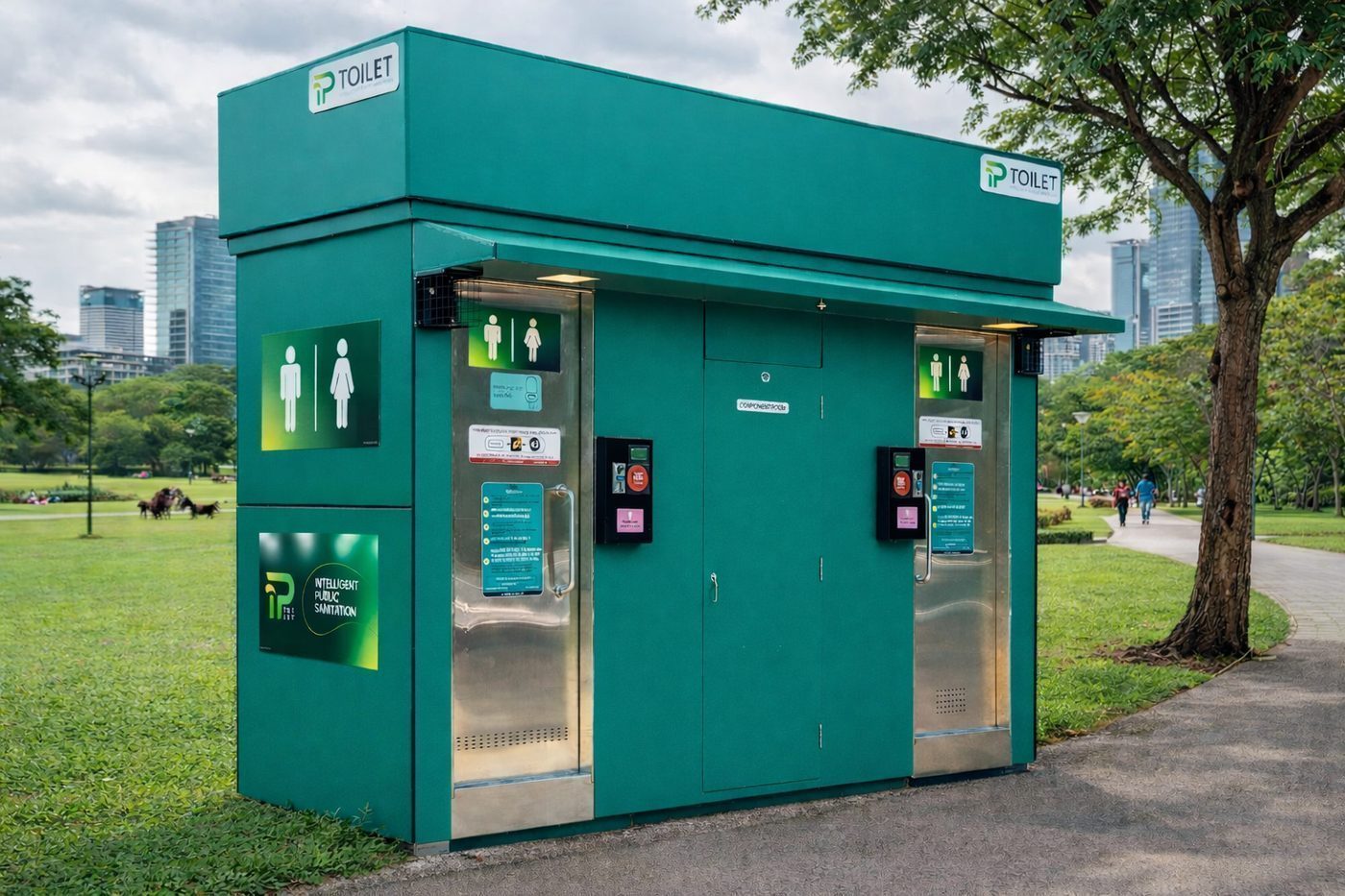
IPToilet® is a factory-made (prefabricated) smart public toilet system designed to solve a basic public sanitation problem: keeping toilets clean and usable for every new user.
Factory-built and factory-tested, IPToilet® provides consistent quality, modular and portable construction, and fast installation, often possible overnight once basic site preparation and utility connections are ready. It offers access options such as coin payment, UPI payment and RFID cards, along with automatic flushing and cleaning, lighting, ventilation and optional remote monitoring.
It is designed for Smart Cities, municipalities, highways, transport hubs, tourist destinations and institutional campuses across India.
The available models are:
| Sl No | Model | Spec | Inside Size | Variants Available | Exterior Size |
|---|---|---|---|---|---|
| 1 | IPToilet® 1010 | Single Premium | perforated floor | 1200 mm x 1200 mm | Automated | 1800mm W x 1380mm D x 2400mm H (500mm canopy on front side; 200mm EWC legs / 400mm IWC legs; 550mm water tank cover) |
| 2 | IPToilet® 1020 | Double Premium | perforated floor | 1200 mm x 1200 mm | Automated | 3600mm W x 1380mm D x 2400mm H (500mm canopy on front side; 200mm EWC legs / 400mm IWC legs; 550mm water tank cover) |
| 3 | IPToilet® 1030 | Single Disable Premium | perforated floor | 2100 mm x 1200 mm | Automated | 2700mm W x 1380mm D x 2400mm H (500mm canopy on front side; 200mm EWC legs / 400mm IWC legs; 550mm water tank cover) |
| 4 | IPToilet® 1011 | Single Economy | Checker plate floor | 900 mm x 1200 mm | Automated & non-automated | 1000mm x 1650mm x 2400mm (legs, canopy and water tank cover excluded) |
| 5 | IPToilet® 1012 | Double Economy | Checker plate floor | 900 mm x 1200 mm | Automated & non-automated | 2000mm W x 1650mm L x 2400mm H (legs, canopy and water tank cover excluded) |
| 6 | IPToilet® 1021 | Single Economy | Checker plate floor | 1200 mm x 1200 mm | Automated & non-automated | 1350mm x 1650mm x 2400mm (legs, canopy and water tank cover excluded) |
| 7 | IPToilet® 1022 | Double Economy | Checker plate floor | 1200 mm x 1200 mm | Automated & non-automated | 2550mm W x 1650mm L x 2400mm H (legs, canopy and water tank cover excluded) |
| 8 | IPToilet® BL 3 | Triple Economy | Checker plate floor | ladies or gents | 1200 mm x 1200 mm | Automated & non-automated | 3700mm W x 2150mm L x 3000mm H (legs, canopy and water tank cover excluded) |
| 9 | IPToilet® BL 6 | Six toilets 1200 x 1200 | Checker plate floor | with passage | ladies or gents | 1200 mm x 1200 mm | Automated & non-automated | 3700mm W x 4300mm L x 3000mm H (legs, canopy and water tank cover excluded) |
| 10 | IPToilet® BL 3+5 | 3 toilets | 5 gents urinals | Checker plate floor | with passage | gents only | 1200 mm x 1200 mm | Automated & non-automated | 3700mm W x 4300mm L x 3000mm H (legs, canopy and water tank cover excluded) |
| 11 | Pathway 1010 | Single Premium | Perforated floor | Shop 2m x 2m | 1200 mm x 1200 mm | Automated | 4000mm W x 2150mm L x 3000mm H (legs, canopy and water tank cover excluded) |
| 12 | Pathway 1011 | Single Economy | Checker plate floor | Shop 2m x 2m | 900 mm x 1200 mm | Automated & non-automated | 4000mm W x 2150mm L x 3000mm H (legs, canopy and water tank cover excluded) |
| 13 | Pathway 1012 | Double Economy | Checker plate floor | Shop 2m x 2m | 900 mm x 1200 mm | Automated & non-automated | 4000mm W x 2150mm L x 3000mm H (legs, canopy and water tank cover excluded) |
Yes. However, developing and testing a custom model requires at least 60 days. The order quantity should also be large enough to support the design and prototype development.
Additional features can be added to the standard model at an extra cost, including:
- Coin or UPI payment
- Indian or Western toilet pans
- Interior fixtures
- Remote monitoring
- Sanitary-napkin vending machine
- Biodigester
- Solar panels
Every feature of IPToilet® is designed with women’s dignity, privacy and safety in mind.
There are two locking systems in an IPToilet® unit. The first is an automatic locking system, which locks the door when the user closes it from inside. The second is a manual internal bolt lock for additional safety. Once the toilet is occupied, the door cannot be opened from outside and can only be opened from inside.
A panic button with a buzzer is provided for emergencies. If the user is unable to open the door, she can press the panic button to alert people outside. Pressing the panic button also releases the automatic door lock, allowing people outside to open the door and assist the user. The door can also be opened from outside through an emergency-access provision, which can be operated only by authorised service personnel.
For comfort, the light and exhaust fan turn on automatically when the toilet is occupied. A 6 × 12-inch window and ventilation louvres at the bottom of the door provide light and ventilation while maintaining privacy.
There is also provision for CCTV outside the toilet unit. These features are designed to provide greater privacy, safety and confidence to women using public toilets.
No. The user will not get locked inside IPToilet®. There are two locking systems:
An automatic lock locks the door when the user closes it from inside. A manual internal bolt lock provides additional safety.
The user can always exit the toilet from inside, even during a power failure.
A battery backup supports the electronic systems for users already inside the toilet. The door can still be opened manually from inside. At the same time, new users cannot enter when electricity is unavailable.
The access control system (coin, UPI payment or push button) prevents a new user from entering when water or electricity is unavailable.
Yes. The user can always open the door manually from inside. In the rare situation where the user is unable to open the door, she can press the panic button, which releases the automatic lock and sounds a buzzer to alert people outside.
The door can then be opened from outside through the emergency-access provision, which is available only to authorised service personnel.
All automated models can include a panic button with a buzzer alarm. The user can press it to alert people outside and request assistance during an emergency.
Yes. Emergency contact numbers are displayed inside and outside the toilet so that users and people nearby can identify the appropriate contact during an emergency.
Yes. CCTV cameras can be installed outside the toilet unit to support user safety and site security during both daytime and nighttime.
The camera system can be specified according to the project’s security requirements. If required, we can provide power points from the central service room and protective camera casings at both ends of the canopy.
Depending on the selected model, access can be controlled through a coin mechanism, push button for free entry, RFID smart card or QR-code payment system.
Yes. A push-button configuration provides access without collecting a user fee.
Yes. Paid access is available through both coin and UPI payment options. UPI access is provided through QR-code scanning. The coin denomination can be customised according to the project requirements.
Yes. UPI payment can be provided through QR-code scanning as a digital access and payment option.
Yes. The IP Toilet can be configured for free public access using a push-button entry system. As long as there is sufficient water in the tank and a reliable power supply, users can access the toilet simply by pressing the button.
Yes. The IP Toilet can be configured for controlled or limited access. RFID cards can be programmed, similar to hotel room access cards, allowing only authorised staff members to access the toilet.
IPToilet® requires a municipal water supply connection. The water line is connected to the unit’s water inlet, and all inlet and outlet points are clearly marked with stickers.
After the unit is installed, a qualified plumber should complete the water connection. If municipal water is not available, the client must provide a borewell.
The standard IPToilet® has a 500-litre water tank, while economy models have a 300-litre tank. Additional tanks can be provided if required.
For maintenance, a ladder is provided to reach the water tank. The ladder is normally kept inside the service room. A sticker marks the correct position where the ladder must be placed. It should be used only at this marked position to prevent damage to the ACP.
In automated models, the water tank has a stainless-steel stand for the water-level sensor, making inspection and servicing easier.
The tank is rectangular, low in height and has a large base area. This helps distribute the weight of the water evenly and makes it easier for service personnel to reach the water-level sensor at the bottom of the tank.
Yes. A 0.5 HP pressure-boosting pump supplies pressurised water for cleaning and other water-operated functions.
In automated toilets, the water pressure is maintained at a minimum of 3 bar for operating the solenoid valves. An authorised service engineer can adjust the pressure if required.
The pump mixes water and air, which helps reduce water consumption while maintaining the required water pressure.
IPToilet® is designed to control water use through automatic valves, sensors, controlled flushing and adjustable cleaning cycles.
Each flush uses 4.5 litres of water, which can be adjusted from the maintenance room. Water used for the 5-metre cleaning hose, handwashing and automatic floor-and-wall cleaning can also be adjusted. Solenoid valves in the maintenance room allow authorised service personnel to adjust the water flow, pressure and operating time as required. In automated models, sensor-based taps provide water only when hands are near the tap, helping prevent unnecessary water use. Push taps are provided in non-automated toilets to help control water consumption.
These controls help reduce water wastage while maintaining the required level of cleaning and hygiene.
The wastewater from the toilet, wash basin and cleaning system flows through the wastewater outlet. The outlet is connected to the site’s sewage system during installation.
IPToilet® can also be connected to an STP or biodigester, where provided by the project owner.
Yes. The sewage outlet can be connected to an existing Sewage Treatment Plant (STP) where required. The STP must be provided separately by the project owner.
Yes. IPToilet® can be connected to a biodigester provided separately by the project owner.
Yes. A water trap should be provided on the wastewater connection to help prevent gases from entering the toilet. The water trap is not supplied with the IPToilet® unit and must be installed by the client during installation.
When the overhead tank is empty, the toilet door will not open. The display next to the door will show ‘No water’, and a voice message in the local language will repeat the message. The tank must have enough water for flushing, handwashing and the health faucet before a user can enter.
The standard IPToilet® configuration requires a single-phase 230 V, 50 Hz, 3 kVA AC supply.
The electrical supply is connected through the designated service-room electrical system. The unit must be properly earthed, with the inbuilt MCB and RCCB switched on during commissioning. Most components inside the IPToilet® operate on DC power.
Yes. A DPMCB rated 230 V/50 Hz, 32 A provides overload and short-circuit protection.
Yes. The electrical arrangement includes an RCCB rated at 230 V/50 Hz, 32 A/30 mA for earth-leakage and electric-shock protection. Proper earthing is also required for the structure, motor and metal electrical boxes.
Yes. The toilet structure, motor and all metal electrical boxes in the service room must be properly earthed during installation.
Yes. The standard configuration uses a 75 Ah maintenance-free battery with a minimum 10 A charger. Certain models have different battery capacities, so the selected model should be checked during procurement.
Battery backup supports the electronic systems for the existing user during a mains power interruption.
Yes, there is battery backup for power failure.
When power fails, battery backup supports the smart functions for the person inside. After that, the toilet will not allow anyone new to enter. The display will show ‘No electricity’, and a voice message in the local language will repeat the message.
No. IPToilet® is designed for automated operation and cannot be operated manually if the automation system fails.
Yes. When a user enters, the system automatically flushes the toilet pan and floor before use. This forms part of the automated hygiene cycle.
Yes. The post-flush mechanism operates automatically after the user exits.
Yes. A manual flush button allows the user to flush the toilet when required.
Yes. A pressurised water-cleaning system is used to clean the toilet floor as part of the automated cleaning cycle.
Yes. Pressurised water jets are used to clean internal wall surfaces, with the system designed to clean wall surfaces up to approximately 4 feet in the applicable configuration.
The cleaning cycle is triggered after the usage count reaches a preset value. The interval can be configured according to the operational requirement; for example, the unit can be configured to clean itself after every ten users.
No. Automatic cleaning reduces repetitive cleaning work, but periodic manual cleaning is still required for proper facility maintenance.
A 5-metre flexible hose with an adjustable nozzle is provided in the maintenance room for pressurised cleaning inside the toilet cubicle and around the unit.
No. During an internal cleaning cycle, the system changes to CLEANING status and prevents new access until cleaning is complete.
A push-button soap dispenser or an automatic soap dispenser can be added to automated models at an additional cost. Soap replenishment is the responsibility of the buyer or facility operator.
Yes. Cleaning staff are required to keep the toilet clean. IPToilet® self-cleans the lower half of the interior, up to 4 feet from the ground, after every 5 or 10 users. This cleaning cycle can be programmed and is completed before a new user enters.
The self-cleaning function reduces the cleaning staff’s workload. However, manual cleaning is still required to keep the toilet and its surroundings clean and usable. Only manual cleaning can remove bottles, plastic covers, wrappers and other objects that users may leave inside.
The major operational challenges in smart toilets are:
Inadequate daily cleaning — Automation does not eliminate the need for regular cleaning of the toilet and its surroundings. Poor cleaning can quickly lead to unhygienic conditions.
Power supply issues — Smart toilets depend on a reliable electricity supply for automated flushing, cleaning, sensors, access control and other systems. Power interruptions can affect operation.
Water availability and quality — Adequate water supply is essential for flushing and cleaning. Low water levels, poor water quality or blocked water lines can affect the system.
Lack of preventive maintenance — Sensors, pumps, valves, electrical components and other equipment require periodic inspection and servicing. Small faults can become major failures if neglected.
Poorly trained or inadequate maintenance staff — Even automated toilets require caretakers to clean the premises, carry out basic checks and report faults promptly.
Vandalism and misuse — Sensors, taps, fixtures and other components can be damaged through deliberate vandalism or improper use.
Neglect of AMC and servicing — Avoiding annual maintenance contracts or scheduled servicing to reduce operating costs can ultimately result in higher repair costs and prolonged downtime.
In short, the biggest misconception is that a smart toilet is maintenance-free. Automation reduces manual effort and improves operational efficiency, but reliable operation still depends on daily cleaning, adequate water and power, trained staff, and regular preventive maintenance.
The IP Toilet is designed to reduce the physical and unpleasant aspects of toilet cleaning. Its self-cleaning facility helps prevent caretakers from having to deal with unflushed toilets. A dedicated service room is provided to store cleaning equipment, along with documented cleaning procedures and maintenance guidelines. Each service room also has a high-pressure jet system for cleaning the toilet and surrounding premises, similar to a car-wash system. A ladder is provided to allow caretakers to safely access the top of the unit and check components such as the water-level sensor inside the tank.
Yes. We provide standard cleaning and operating procedures for cleaning staff to follow, ensuring that the toilet and its surroundings are cleaned and maintained properly.
We provide detailed guidelines on the recommended cleaning materials and products for both the interior and exterior of the IP Toilet with every purchase. This information is shared with our partners and customers and is also made available to caretakers to ensure that the appropriate materials are used for safe and effective cleaning.
The IP Toilet has a recessed waste bin located inside the toilet, with a separate access lid opening into the service/maintenance room. The bin is clearly marked for easy identification. The caretaker can access and empty the bin from the service room and should dispose of the collected waste once a day as part of the routine cleaning procedure.
The waste can be easily accessed and removed by the cleaning staff from the service/maintenance room and disposed of through the designated waste disposal system.
Yes. Each cubicle has ventilation through an exhaust fan, along with a 12 × 6-inch window and louvres at the bottom of the door. The exhaust fan operates automatically when the cubicle is in use.
Yes. Internal lighting activates when the toilet is occupied, while external lighting can activate automatically during low-light conditions using a day/night sensor.
Yes. Voice guidance provides users with instructions for entering and using the toilet in the local language.
Yes. Graphic LCD/LED displays and infographics can provide status information and instructions for users. Digital payment can also be supported through the LCD display using a dynamic QR code, which is generated instantly and shows the toilet’s operational status.
Yes. Infographics can be provided in local languages for easy understanding.
Each cubicle has an automatically operated exhaust fan, along with a 6 × 12-inch window and ventilation louvres at the bottom of the door. These provide continuous ventilation while maintaining user privacy.
IPToilet® normally uses SS304 stainless steel for interior panels and fixtures. SS316L is used for the floor in specified configurations for better resistance to corrosion, chemicals and stains. SS316 can also be considered for coastal areas where required.
Stainless steel is used because it is strong, durable, hygienic and easy to clean. IPToilet® uses SS304 for interior panels and fixtures, including wash basins and toilet pans, instead of breakable ceramic fixtures. It also helps reduce corrosion, staining, tampering and vandalism, making the toilet suitable for heavy public use.
IPToilet® uses strong stainless-steel components, secure fixtures and concealed technical systems to reduce tampering and vandalism. SS304 wash basins and toilet pans are used instead of breakable ceramic fixtures.
Fixtures such as wash basins, taps, lights and exhaust fans are secured in a tamper- and theft-resistant manner. Internal components are fixed using Allen K CSK fasteners, with many screws and fasteners positioned behind the SS wall panels, making them difficult to access or remove from inside the toilet.
Technical equipment such as the battery, pump, plumbing, electrical equipment, sensors, control boards and IoT devices is housed in a dedicated service area accessible only to authorised maintenance personnel.
The space between two toilet units is provided as a maintenance and service room. It has enough space for a service engineer to carry out maintenance work and houses the power, plumbing and other technical components, including the battery, motor, sensors and control box. It also stores the basic maintenance toolkit, technical drawings and 5-metre hose with nozzle.
Keeping the technical components in the service room ensures that no technical equipment is placed inside the toilet cubicle, making the cubicle easier to use and maintain.
Depending on the model, exterior construction can use ACP, GRP, PUF or similar aesthetic antifungal materials. The selected material can be chosen by the client according to the project requirement.
ACP provides an architectural exterior finish while allowing protected service spaces for plumbing and electrical systems between the ACP and the SS interior wall. ACP is available in different colours, textures and thicknesses. Some colours have UV protection, and the ACP can be replaced if required.
IPToilet® uses a patent-pending engineered floor drainage system designed to work with its self-cleaning system. Rapid drainage reduces standing water, helping improve hygiene and reduce slippery conditions.
The perforated-floor configuration allows water to drain rapidly through the floor. Non-perforated checker-plate models also use fabrication methods designed to reduce standing water, although the perforated floor provides more efficient drainage.
An engineered SS316 perforated floor with a slanted under-tray provides rapid drainage and high corrosion resistance. These features are useful where floors are repeatedly exposed to water, wastewater and cleaning chemicals.
IPToilet® uses SS316L for the floor in the specified configuration to improve resistance to corrosion, chemicals and stains. SS304 is normally used for interior wall panels and fixtures. SS316 can be considered for coastal areas where required and affordable.
Yes. Wash basins are provided inside the toilet cubicles, with dimensions and configurations varying by model.
Yes. A proximity sensor detects the user's hand and automatically operates the wash tap, reducing the need to touch the tap.
Yes. A health faucet is included in the specified toilet configurations.
Yes. A stainless-steel anti-tampering mirror is provided near the wash basin.
Yes. Stainless-steel bag or clothing holders can be provided inside the cubicle.
Yes. A vandal-resistant SS304 Indian-style toilet pan is available in the applicable configuration.
Yes. Western-style EWC in SS304 with floor-mount configurations are available for applicable models, subject to the selected specification.
Yes. Sanitary-pad vending and incineration equipment can be included where required by the project for additional cost. It will be installed on the exterior of the toilet unit.
Yes. Premium models include climate-control provisions for hot-climate locations, with insulation between the interior and exterior walls. Climate-control provisions can also be added to economy models at an additional cost.
Yes. A steel mug is provided with the Indian-style toilet pan.
Yes. UV lighting can be provided inside the toilet at an additional cost as an optional hygiene feature. Contact us for details on the available configuration.
We use ACP panels with a 10-year warranty. Some ACP colours also have UV protection. If the panels are not physically damaged and are cleaned once a year, they can remain in good condition for 10 years. The ACP cladding can also be replaced if required.
IPToilet® uses strong, non-breakable SS304 wash basins and toilet pans instead of ceramic fixtures. Internal components are secured with Allen K CSK fasteners, and many screws and fasteners are placed behind the SS wall panels, making them difficult to access and remove from inside the toilet.
Self-cleaning and the perforated floor help keep the toilet clean and well drained. Toilet bowls have P-traps, and the wastewater outlet has water traps to help prevent bad odours from entering the toilet.
UV light can also be provided as an optional feature to help control odour-causing microorganisms.
IPToilet® is designed with ground-bolting provisions to withstand moderate winds and storms. Thermal insulation is provided between the internal steel wall and the external ACP wall to help reduce the effect of high temperatures.
However, performance during extreme weather conditions such as cyclones cannot be guaranteed and should be assessed based on the specific site and local conditions.
The space between two toilet units is provided as a maintenance and service room. It has enough space for a service engineer to carry out maintenance work and houses the power, plumbing and other technical components, including the battery, motor, sensors and control box. It also stores the basic maintenance toolkit, technical drawings and 5-metre hose with nozzle.
Keeping the technical components in the service room ensures that no technical equipment is placed inside the toilet cubicle, making the cubicle easier to use and maintain.
No. Internet connectivity is optional for basic toilet operation but is required for remote monitoring through the web-based dashboard.
Yes. Connected units can transmit operating information to a web-based dashboard, allowing authorised personnel to monitor multiple facilities through a centralised system.
Yes. The system can notify the server when a usage cycle starts and when it is completed. This provides useful operational information for facility management.
Yes. Remote status information can help identify conditions such as water or electricity unavailability and toilet operating status, allowing maintenance teams to prioritise interventions.
Yes. Automation reduces repetitive tasks but does not eliminate maintenance. Periodic inspection, manual cleaning, battery checks, sensor adjustment and component maintenance remain necessary for reliable long-term operation.
Battery health should be checked once a month to support reliable operation and extend battery service life.
Yes. We provide a manual with detailed instructions and diagrams. We also provide a toolkit with essential tools.
To provide local service support, there should be at least 5 units within a 5–10 km radius, with a caretaker available for the units. Contact us for more details.
The system will shut down until the faulty sensor, valve or component is repaired or replaced.
Most components are available in the market or from our store. Control boards are not normally available in the local market.
Normally, service personnel can attend within 24 hours in areas where we have partner networks. In other areas, response time depends on the location.
Yes. Working status, payment status, water availability, troubleshooting status, opening time, closing time and shutdown time can be monitored. Periodic reports can also be obtained.
The maintenance room has a service door with a key. The keys are given only to authorised persons only.
We have documented daily, monthly, quarterly and annual maintenance procedures covering cleaning, inspection, servicing and preventive maintenance. These procedures are provided to our partners and customers after the purchase of an IP Toilet, helping ensure reliable operation and extend the life of the system.
Yes. We provide a detailed operating and maintenance manual with every IP Toilet. We are also developing a mobile application for maintenance staff and operators to manage maintenance activities, payments and other operational requirements. APIs are available for integration with existing software and management systems. These resources and integration capabilities are available to our partners.
Because IPToilet® is prefabricated, site work is mainly limited to preparing the PCC and RCC platform, water and sewage connections, electrical connection, and other project-specific civil work.
Installation involves site preparation, construction of a level 5-inch PCC and RCC platform, positioning the unit, water and sewage connections, and electrical connection. Network connectivity can be added where remote monitoring is required.
Yes. Four lifting hooks are provided at the top corners for crane loading and unloading. All four hooks must be used simultaneously during lifting.
Yes. The packaging arrangement provides clearance underneath for forklift handling.
Yes. The main advantage is that the existing site is already suitable for IPToilet® installation, with water supply, sewage connection, electricity and maintenance access already available.
Yes. Water, sewage and electrical connections should be completed by appropriately qualified personnel. The installation guidance recommends using a certified plumber/electrician for the relevant connections.
Yes. IPToilet® units can be relocated if site requirements change. Each unit has four crane-liftable hooks on the top, allowing it to be safely loaded, unloaded and moved by crane.
The modular and portable design makes relocation possible where site conditions and project requirements allow. Before relocation, the site access, utility connections and site preparation requirements should be checked.
Installation includes basic civil work as required for the selected model, along with water, sewage, electrical and, if required, internet connections. The cost depends on the location. Under normal conditions, these works may cost around ₹50,000 for a twin toilet unit, with a slight variation for a single unit.
After the toilet reaches the site, tile paving is done to create a raised platform, along with a ramp where required for disabled access.
The civil work and its cost will depend on the contract between the contractor and the urban local body.
After basic site preparation is completed, overnight installation is possible.
A 5-inch PCC and RCC platform is required before installation, along with water, sewage and electricity connections.
Yes, we can provide a detailed civil work drawing If you order our products or become our partner.
Yes, we can connect you with our regional partners.
The time required to dispatch an IPToilet® unit from the factory depends on the model, quantity, additional fittings and requested features. One or two standard models without additional fittings can sometimes be dispatched within one to two weeks. However, buyers often request additional fittings or features even with standard models, which may require additional procurement time. In such cases, delivery may take up to one month.
For bulk orders of around 100 to 200 units, the delivery schedule can be mutually agreed upon based on the project requirements. The units can be manufactured and delivered in batches, with the number of units in each batch agreed upon in advance.
Normally, IPToilet® units are packaged with a first layer of plastic sheet, followed by a second layer of stretch film. Finally, the units are covered with polyethylene shade nets for protection during transportation. For overseas transportation, or if required by the client for domestic transportation, the units can be packed in wooden boxes for additional protection.
IPToilet® units are transported on trucks, securely packaged and protected for the journey. The units are unloaded and positioned at the site using a suitable crane.
Please contact us for details on transportation costs, as these depend on the delivery location, order quantity and specific project requirements.
Pathway combines two smart toilet cubicles with an integrated commercial kiosk in one prefabricated structure. It is designed to combine public sanitation with a potential revenue-generating urban utility.
The typical Pathway configuration contains two toilet cubicles—one Ladies and one Gents—together with a shop/kiosk in a single factory-made structure.
The kiosk can be configured for uses such as a tea shop, medical store, aid post, EV charging facility or another public utility service, depending on the project requirement. The important thing is that the kiosk operator will be responsible for the upkeep of the toilet.
Yes. The kiosk can accommodate a revenue-generating commercial or public-utility activity. Its ability to support toilet operation and maintenance depends on location, footfall, business model and operating arrangements.
Yes. A designated area for smart backlit advertising can provide an additional revenue stream that can contribute toward operation and maintenance of the facility.
Yes. Push-button access can be selected so that the public can use the toilets without paying a user fee.
Yes. A coin-based access mechanism can be selected where paid access is required, with the coin denomination customisable according to the project requirement.
Yes. QR-code scanning with a mobile application can be provided for digital payment and access control.
Revenue from the kiosk and advertising can be allocated toward cleaning, operation and maintenance of the integrated facility. Actual revenue and cost recovery depend on location, footfall, tenancy, advertising demand and the operating agreement.
No. The Pathway model is designed to create revenue opportunities that can offset operating expenses. Actual costs for utilities, maintenance, staffing and connectivity depend on the project-specific operating arrangement.
The Pathway models have different overall dimensions. The selected Pathway model and its dimensions should be confirmed during procurement.
The approximate weight is 1,600 kg.
Yes. The kiosk can be customised with features such as air conditioning, glass panels, racks and customer counters, according to the intended use.
Yes. A designated advertising area can be incorporated into the toilet unit at an additional cost. Contact us for details on available advertising configurations.
Yes. Solar panels can be incorporated into the toilet installation, subject to the selected model and site requirements. Contact us for information on available configurations.
Yes. EV charging facilities can be incorporated into suitable IPToilet® installations, subject to the selected model, electrical requirements and site conditions. Contact us for details.
Yes. The Pathway roof structure is reinforced to support a 500-litre water tank.
Yes. A canopy extension is provided on both entrance sides to protect users waiting near the toilet from rain. A sensor-based LED light is also provided for the canopy.
Yes. We can help you by connecting you with our partner near you to assist you in participating in the tender.
Please contact us to get this information.
Yes. The required configuration and optional features can be selected based on the project’s operational requirements.
Yes, we can arrange for our partners to do this.
Yes. We provide our partners with presentations, tender assistance, joint venture (JV) support and exclusive rights for specific tenders, where applicable.
yes, company can provide service and spareparts if you have trained technician. Apart from that, operations and maintenace can be undertaken by our partners locally. Charges for these service depends on number of units purchased and area.
A one-year comprehensive warranty is provided by the partner from the date of commissioning, as per the stated warranty terms.
No. Dimensions, materials, battery capacity, water capacity, fixtures and other features can vary between models.
The contractor should check that the platform is level and that water, sewage and electrical connections are ready. Installation and maintenance access should also be confirmed. If remote monitoring is required, network connectivity should be arranged. Completing these requirements before delivery helps avoid installation delays.
Yes. AMC is available and covers maintenance activities and troubleshooting, excluding daily operations and structural damage.
On top of the AMC the company can also arrange local partners to handle daily operations and maintenance, including:
Staff training Toiletries and consumables Water and electricity payments Structural repairs Day-to-day toilet operations
The cost of this depends on the number of units purchased and the location.
Yes. Our authorised partners will handle client interaction, annual maintenance and last-mile service. Daily operation costs may vary depending on the number of installations in a particular area.
Our authorised partners are trained to provide reliable local client service and support.
Yes. We provide training, video-call assistance and detailed documentation with drawings. The toilet unit also comes with a service toolkit for basic maintenance and a ladder to access the water tank for maintenance.
We are in the process of obtaining certification for our models. Our parts and components are ISI certified. We use branded fittings and imported sensors and electronic components.
Yes. The fittings inside the toilet are designed according to international standards. We use imported bearing hinges for the doors. The size and position of support handles and the lighting brightness are also designed according to international standards.
If the unit is properly maintained and covered by an AMC, its expected service life is 15 years.
One year.
The warranty covers plumbing, batteries, sensors, pipe fittings, electronic and electrical components and ensures the normal functioning of the toilet systems. It does not cover structural damage caused by vandalism or natural calamities, or damage caused by non-use or improper use. Daily operations, consumables and cleaning are not covered under the warranty.
Yes
Our partners should have the financial capacity to purchase the toilets with 100% advance payment. We first sign an MOU and Partner Agreement. Partners must complete the required training and sign an agreement to protect our IP rights.
We also offer co-branding opportunities to our partners.
The company will charge ₹2,500 for single-unit components and ₹3,500 for automation components after the warranty period. This includes video-call assistance and the online monitoring licence.
If a company technician is required, the technician can be sent at the actual travel cost.
Daily operations, consumables and cleaning costs are extra.
No. We do not offer exclusive marketing rights for any state or region. However, partners can receive exclusivity for specific tenders or leads that they have formally registered with the company in advance. This ensures that partners are protected for opportunities they have identified and initiated.
Yes. Partners may use co-branding alongside the company's brand, subject to the company's branding guidelines and protection of its intellectual property and brand rights.
Yes. The IP Toilet includes provisions for buyer branding, allowing municipalities to display their logo and branding in designated areas while maintaining the integrity of the IP Toilet's design and brand identity.
The IP Toilet offers dedicated spaces for paid advertising. For a twin-unit toilet, the entire 12 ft × 10 ft rear surface can be used for advertising, with the option to extend the advertising space up to 5 ft above the top of the toilet. Additional advertising space of approximately 5 ft in width is available on both sides of the unit.
The company normally charges 25% of the user fee collected for managing the UPI-based payment and collection system.
Automated entry control, pre-wetting, flushing, self-cleaning and remote monitoring can reduce repetitive work and make toilet management more efficient and systematic. Cleaning staff spend less time at each unit, allowing them to service more toilets each day and helping reduce operating costs.
Automatic systems also control water use, supporting better water management. A common problem with public toilets is misuse and dirtying when water or electricity is unavailable. Automatic IPToilet® units do not allow entry when water or electricity is unavailable, helping prevent this problem.
Yes. Remote status information allows authorised personnel to check connected toilet units without visiting each location for routine checks. This helps facility managers decide which units need priority for cleaning, maintenance or repairs.
Accessible public toilets are a sign of a well-planned and caring city. They make it easier for people with disabilities to use public spaces independently.
IPToilet® offers a dedicated Disabled Toilet model (IPToilet® 1030), helping urban areas provide accessible public toilets wherever they are needed.
Clean, accessible and reliable public toilets give people confidence to use and enjoy public spaces. They are especially important at tourist places, transport facilities, markets and other busy urban areas.
For tourists, clean public toilets make it easier to spend more time at a destination. In the same way, clean toilets in urban areas encourage people to spend more time shopping and using public spaces. They are also important for people in transit, students and gig workers.
Knowing that a clean public toilet is nearby makes people feel more comfortable and helps them enjoy the benefits of urban life.
A self-cleaning smart toilet is designed to present a clean and usable toilet to every new user. Public toilets are used by people from different backgrounds, and some users may leave the toilet unclean. IPToilet® addresses this by automatically flushing and cleaning the toilet before the next user.
Compared with a conventional public toilet, an automatic IPToilet® can:
Reduce cleaning workload: Automatic entry control, flushing, self-cleaning and remote monitoring reduce repetitive work. A cleaner can service more toilet units each day. Control water and electricity use: Water is supplied in controlled quantities, and lighting and ventilation operate only when required. Prevent use during water or power failure: The toilet does not allow new users to enter when water or electricity is unavailable, helping prevent the facility from becoming dirty or unusable. Detect problems earlier: Remote monitoring can alert authorised personnel to issues such as water leakage, helping repairs to be taken up earlier. Improve maintenance planning: Facility managers can identify which units need cleaning, maintenance or repair and prioritise the work. Reduce operating costs: Lower cleaning time, controlled water and electricity use, and early detection of faults can reduce the lifetime operating cost of the facility.
Overall, automation helps make public toilet operation cleaner, more systematic and easier to manage than a conventional toilet.
IPToilet® uses controlled amounts of water and electricity, helping reduce unnecessary consumption.
Controlled water use: The water used for each flush and self-cleaning cycle is calibrated and can be adjusted as required. Efficient lighting and ventilation: Interior lights and exhaust fans operate when the toilet is in use, reducing unnecessary electricity consumption. Automatic exterior lighting: Exterior lights switch on at sunset and off at sunrise, helping prevent electricity wastage.
This helps IPToilet® use water and electricity more efficiently than conventional public toilets.
In models designed for children, the size and height of toilet seats, wash basins, handrails and door locks are designed according to applicable national standards. The toilet interiors are also larger, allowing a parent to stay inside when needed.
For elderly users, safety handrails are provided along the side walls.
The disabled toilet has enough space for a wheelchair to enter, turn and exit comfortably. Ramps with guardrails are also provided outside the toilet for easier and safer access.
Yes it is accessible for wheelchair users
IPToilet® detects when a person approaches the unit. It then provides voice guidance and shows whether the toilet is ready to use, occupied, or unavailable due to no water or electricity.
Depending on the selected access-control system, the user can request entry using a coin, push button, RFID card or QR-code payment.
The system activates voice guidance, pre-wetting, lighting, fan and ventilation when a user enters. The display changes to indicate that the toilet is in use. The system can also notify the monitoring server when connected.
The fan, light and exhaust are switched off, the automatic post-flush operates and the system can notify the monitoring server that the usage cycle has been completed.
The standard operating sequence allows a maximum usage duration of 20 minutes, configurable according to the requirement. If the configured period is exceeded, the system can switch off the fan, light and exhaust and notify the server.
A door sensor monitors the door position. If the door remains open for an extended period, the system can produce a beep alarm to alert the user.
The selected model should match the expected footfall, site dimensions, accessibility requirements, water and sewage infrastructure, electrical supply, access-control method, maintenance strategy and operating model. Selecting the configuration at the planning stage helps reduce installation changes and supports better lifecycle performance.
A successful public toilet remains clean, safe, accessible, durable and operational throughout its service life. For municipalities, this means manageable maintenance and lifecycle costs; for contractors, predictable installation; and for users, a reliable and dignified sanitation facility.
Modern public toilets combine durable construction, accessibility, hygiene features, automation and operational monitoring. This can improve the user experience while making maintenance and asset management more systematic.
Common causes include poor site selection, inadequate maintenance planning, unsuitable materials, vandalism, insufficient budgeting and unclear operational responsibility. Addressing these issues during planning improves the likelihood of reliable long-term operation.
Evaluate durability, accessibility, hygiene, vandal resistance, maintenance requirements, lifecycle cost, utility requirements, installation requirements and installation time and user experience. The lowest initial purchase price should not be the only evaluation criterion.
IPToilet® combines modern design aesthetics, prefabricated modular construction, stainless-steel interiors, automated flushing and cleaning, controlled access, safety features, anti-vandalism features and optional remote monitoring. It also allows overnight installation and is portable to a new location when needed. The combination is intended to support reliable operation, durability, reduced manual cleaning and easier management of urban public sanitation facilities.
Select the site based on public need, expected footfall, visibility, accessibility, security, water, sewage, electricity, drainage and maintenance access. The location should also remain relevant as the surrounding urban area develops.
Expected footfall determines the appropriate number and configuration of cubicles. High-demand locations may require larger multi-cubicle facilities, while smaller urban locations may be adequately served by single or double units.
High-footfall locations such as transport hubs, markets, tourist destinations, pilgrimage centres and major public spaces may justify separate facilities for men and women together with accessible facilities. Smaller locations may require only single or double cubicles.
The project should confirm municipal water supply, sewage connection, electrical power, installation access and adequate maintenance access before procurement. Early utility planning helps avoid delays during installation.
Cleaning, consumable replenishment, inspection and preventive maintenance are recurring requirements. Defining these responsibilities before commissioning helps protect the asset and maintain service quality.
A public toilet continues to incur costs for cleaning, utilities, repairs, maintenance and component replacement after installation. Lifecycle-cost evaluation gives municipalities a more meaningful basis for comparing competing infrastructure options.
Public sanitation should be planned with future demand in mind rather than only today's requirements. Considering population growth, changing footfall and surrounding development helps ensure that the facility remains useful and maintainable over the long term.